Viola Eade
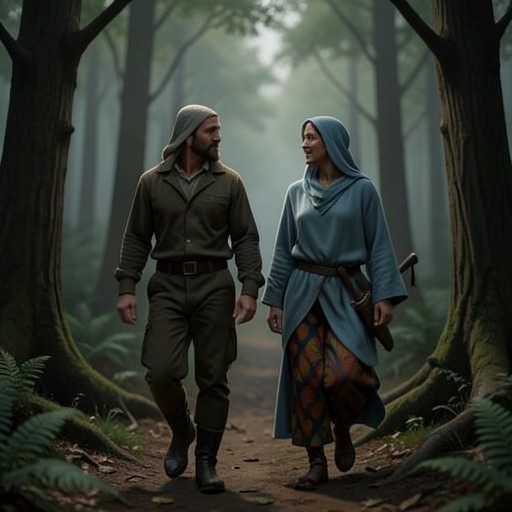
The Knife of Never Letting GoViola Eade is a settler stranded on the New World after her scout ship crashes. She enters Todd Hewitt’s life as a silent stranger pursued by Aaron, but her silence conceals neither fear nor judgment: she recognizes Todd’s capacity not to harm her before he understands her circumstances, and later acts decisively to protect him. As the two come to rely on each other, she becomes central to the story’s distinction between what a person appears to be and what that person chooses to do.
Identity and Arrival
Todd first understands Viola’s larger purpose when he realizes she is a new settler. The ship she crashed in is too small to be the vessel carrying a settlement; Viola explains that it was a scout and that her home ship is an Expansion Class Seven Colony Ship. This disclosure places her arrival within a future-facing colonial mission, even as her immediate circumstances are defined by isolation and danger. The distinction between scout and home ship also shows that the vessel found in the swamp is not the end of the journey she was meant to make.
Viola gives Todd her full name when she introduces herself as Viola Eade and spells out her surname. The exchange is a small but significant act of self-presentation: the girl he has encountered first as a silent presence becomes a person with a name she chooses to share. She holds out her hand as she does so. Todd, who is preoccupied with the approaching threshold of manhood and the family he has lost, receives that introduction at a moment when his own identity is unsettled.
Her silence is a consequence of the contrast between her and the men around her, not evidence that she has nothing to communicate. Todd gradually learns to attend to her expression and body language rather than expecting Noise. His later recognition that silence is not emptiness gives their relationship a language beyond speech and makes his understanding of her an important part of his own development.
Flight, Trust, and Mutual Care
When Viola explains what happened before Todd found her, she says she had been running from Aaron for four days. Todd was only the second person she had seen on the planet, and he approached her carrying the same knife as the man she had fled. From her perspective, caution was necessary: she had no reason at first to know that Todd was different. Yet she could tell, even before she understood the Noise or the history of Prentisstown, that he would not hurt her. Her judgment rests on what she can perceive of him, rather than on the explanations he can offer.
The trust between them becomes reciprocal rather than a simple rescue relationship. During their flight, Todd asks Manchee to smell for Viola and to tell him whether she is still alive; Manchee’s report that she is afraid quickens Todd’s pursuit. The scene shows how her peril remains present even when she is out of sight, and how Todd’s concern directs his actions. Later, when Ben asks whether she has been taking care of Todd, Viola answers that they have been taking care of each other. Ben’s warm, sorrowful response recognizes the partnership they have formed without reducing it to one person’s protection of the other.
Their trust does not erase the unevenness of what they know. When Todd learns that Viola had told Hildy about the settler ship before telling him, he feels excluded, although he recognizes that he had not asked. The disclosure leaves him with a sour sense of being the last to know; it also shows that Viola has relationships and exchanges beyond the bond developing between them. Her connection with Hildy and Tam is part of the social world she builds while travelling with Todd, not merely an extension of his perspective.
Witness to the Past of Prentisstown
Viola is present as Todd and Ben confront the history that shaped Prentisstown. Ben explains that hardship across the New World—failed crops, sickness, and lack of prosperity—was followed by preaching that assigned blame. When Viola identifies the people being blamed as aliens, Todd names the Spackle, and Ben confirms that the accusation became a movement and then a war. He describes the imbalance of force: humans had guns, while the Spackle did not. The story of that violence helps explain the prejudice Todd has inherited and the shame he feels when its consequences are made explicit.
The account turns from the war against the Spackle to violence within Prentisstown. Todd says that the men of the town killed the women; Ben confirms that many men did so under the influence of Mayor Prentiss and Aaron’s preaching, and that men who tried to protect the women were killed as well. Viola gasps as the truth is spoken, while Todd names his mother and Ben confirms her fate with a nod. Her presence matters here because the revelation is not only a piece of Todd’s past: it is shared with the person whose trust has already challenged the assumptions that governed his community.
Todd later understands that Prentisstown’s coming-of-age killings relied on a wider conspiracy. Men thought to have disappeared had in fact been killed, sometimes by boys made to act alone on their thirteenth birthdays while the town’s men watched. Other escapees could be seized, or an unpopular townsman could be falsely said to have disappeared. Todd concludes that everyone was complicit and guilty except himself. Viola is there as he faces this history, and her startled response marks the moral weight of what he has uncovered. The ritual’s claim that a boy becomes a man through killing is set against the mutual care she and Todd have practiced.
Defiance of Aaron and the Choice of the Knife
At the church confrontation, Viola does not remain a passive object of the struggle between Todd and Aaron. When Todd is in danger, she hurls a large, flat stone at Aaron. He ducks and tries to deflect it, but the blow makes him stumble away from both Viola and Todd and toward the front of the church. The act creates an opening for Todd to get back on his feet and for the two of them to move together. Her intervention is physical and immediate, but it also continues the pattern established earlier: she acts on her understanding of what Todd needs rather than waiting for him to protect her.
As the confrontation reaches its decisive moment, Viola’s hand is the first to meet Todd’s. She takes the knife and uses it against Aaron, killing him and ending his pursuit of them. Afterwards, she explains that she could not let Todd do it because Aaron would have won; she also knew Todd would have been willing to act. Her explanation makes the moment more than a reversal in who holds the weapon. Viola prevents Aaron from defining the choice Todd must make, and accepts the decisive action herself.
The contrast between the knife and the earlier coming-of-age killings is essential to the scene. In Prentisstown, violence had been organized as a public rule, with a boy’s act used to certify him as a man and the community’s watching serving as complicity. Here, the knife appears within an immediate struggle, and Viola’s decision is presented as her own. Her intervention protects Todd from being forced into Aaron’s design, while also making her an agent in the outcome rather than merely someone to be rescued.
Wounding and Narrative Significance
After Aaron’s death, Viola is wounded. Todd carries her onward, and when he encounters Mayor Prentiss, he pleads for the Mayor to save her and offers to join the army in exchange. The request brings their relationship to a point of acute dependence: the boy who has spent the story escaping the Mayor’s pursuit asks the ruler for help because Viola’s life is at stake. The available scene ends with the Mayor dismounting and removing his gloves, leaving the immediate outcome of Todd’s plea unresolved here.
Viola’s role joins the story’s questions about silence, knowledge, and moral choice. She arrives as someone Todd cannot read through Noise, but the absence of Noise never amounts to an absence of feeling or intention. He learns to recognize her through attention to her words, expressions, and actions. The person first met under conditions of fear becomes the one who sees that Todd will not hurt her, shares the burden of survival with him, and finally acts before he can take the knife. Her silence remains a difference between them; their relationship makes it a difference Todd learns to understand rather than a blank he can fill with his own assumptions.